
Supply Chain Management Software: A Comparative Look at the 5 Core Tool Categories
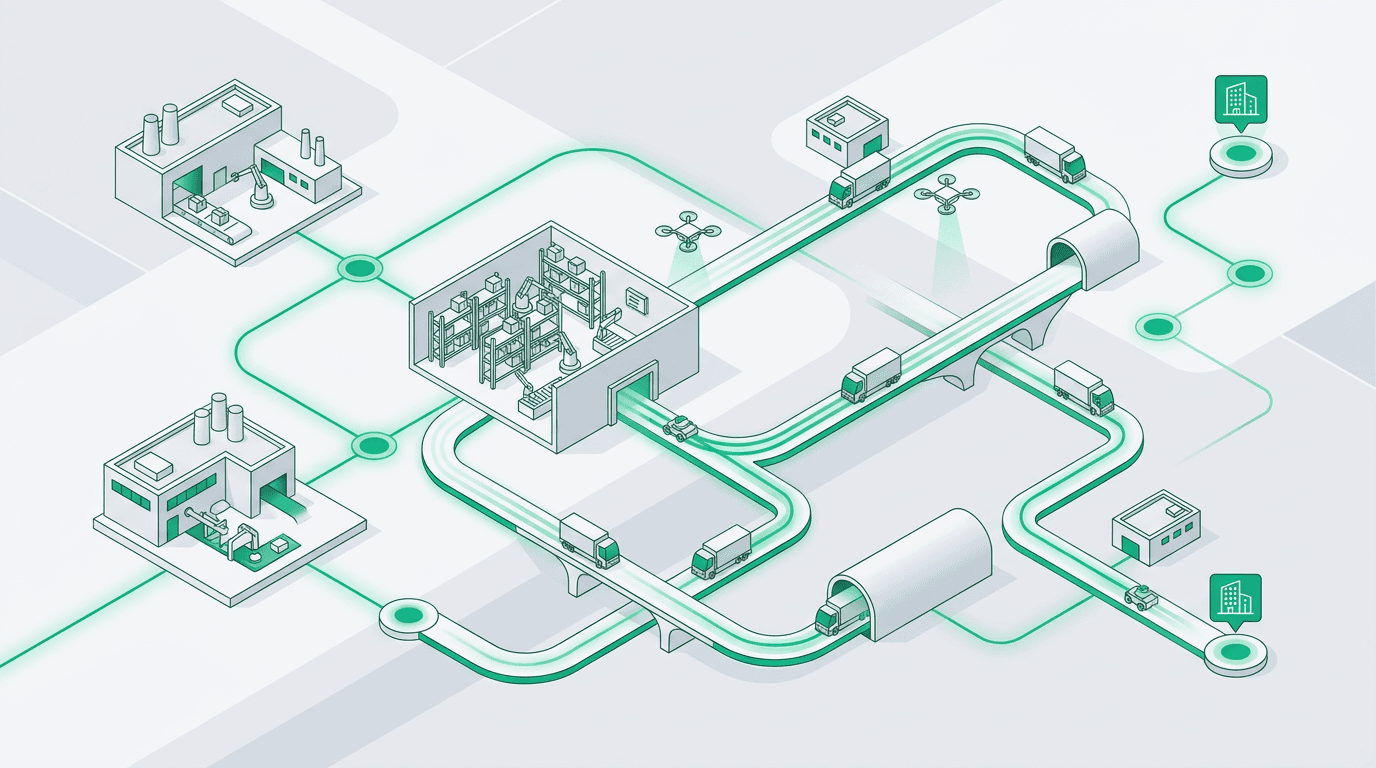
"Supply chain management software" is not one product. It is a category that spans everything from demand forecasting to dock scheduling, and the tools inside it overlap, compete, and integrate in ways that make buying decisions genuinely hard. This is a comparative look at the five core categories of supply chain software, what each one does, and the question that matters most for distributors: should you assemble best-of-breed tools, or run your supply chain on one platform?
What supply chain management software actually covers
Supply chain management (SCM) software helps a business plan, source, move, and track goods from suppliers to customers. For a distributor, that means forecasting demand, replenishing stock, coordinating with vendors, running the warehouse, and seeing the whole flow in real time. The five categories below map to those jobs.
The 5 core categories
1. Demand planning and forecasting
These tools turn sales history, seasonality, and trends into a forecast you can buy against. Good forecasting reduces both stockouts and dead inventory. The weakness of standalone forecasting tools is that they are only as current as the sales and inventory data you feed them, which is why forecasting works best when it lives on the same system as your orders.
2. Inventory and replenishment
This is where distributors win or lose on cash. Replenishment software calculates reorder points and suggests purchase orders using demand velocity, lead time, and safety stock. Compared to spreadsheets, it pays for itself quickly. Compared to a forecasting tool, it is more operational: it tells you what to buy today, not just what demand might look like next quarter.
3. Supplier collaboration and procurement
Purchase orders, vendor terms, acknowledgments, and inbound visibility live here. The value is in reducing the back-and-forth with suppliers and catching problems before goods arrive. These tools matter most for distributors with deep vendor relationships, but they create the most friction when they sit apart from purchasing and inventory.
4. Warehouse management
Receiving, putaway, picking, and shipping. Warehouse management software (WMS) drives the physical motion of your supply chain with barcode and mobile workflows. A powerful WMS that does not talk to inventory in real time is worse than a simpler one that does, because the gap between physical and recorded stock is exactly what a WMS is supposed to close.
5. Supply chain visibility and analytics
Dashboards and reporting that tie the other four together: fill rates, inventory turns, on-time delivery, aging. Visibility tools are only as trustworthy as their inputs. When every category above runs on a different system, "visibility" becomes the work of reconciling four exports, which defeats the purpose.
The real comparison: best-of-breed vs. one platform
The honest comparison is not tool versus tool. It is best-of-breed versus unified.
Best-of-breed lets you pick the strongest product in each category. The cost is integration: every tool is a separate system to sync, secure, and reconcile, and the seams between them are where data drifts and visibility breaks down.
One unified platform runs demand, inventory, procurement, warehouse, and analytics on a single real-time dataset. You give up some depth in any single category in exchange for eliminating the integration tax entirely. For most distributors, the integration tax is the larger cost.
The right answer depends on your size and complexity, but the question to ask is concrete: how much of your team's week goes to moving data between systems rather than acting on it?
How distributors should choose
A few questions cut through the marketing:
Where does my data actually live? If the answer is "in five places," visibility will always be a reconciliation project.
Was it built for distribution? Native units of measure, landed cost, and vendor terms are hard to bolt on later.
Can it grow with me? The cost of re-platforming later usually dwarfs the feature gap today.
10X ERP takes the unified approach: demand planning, replenishment, purchasing, warehouse, and real-time analytics run on one API-first platform built for distributors, with 10X AI on top so you can question your live supply chain data in plain English. If you want to see what one connected system looks like, schedule a 30-minute demo. You can also read our guide to wholesale distribution software for the broader operational picture.
Frequently asked questions
What are the main types of supply chain management software? The five core categories are demand planning and forecasting, inventory and replenishment, supplier collaboration and procurement, warehouse management, and supply chain visibility and analytics. Many platforms combine several of these into one system.
Is it better to use separate supply chain tools or one platform? Separate best-of-breed tools can be stronger feature by feature, but each integration adds syncing and reconciliation work. For most distributors, a single platform that runs these functions on one dataset is more efficient because it removes that integration overhead.
What supply chain software do distributors need most? Inventory and replenishment is usually the highest-impact category for distributors because it directly controls cash tied up in stock and the stockouts that cost sales. It works best when connected to demand planning and purchasing.
Ready to Transform Your Distribution Business?
Let us help you implement solutions that drive real results.
Contact Us TodayGet insights delivered to your inbox
Product updates, distribution industry insights, and company news.
Related Articles
Prepare Your Distribution Operations for 2027
A Q4 checklist for fastener, sealing and industrial distributors, with real results from distributors who gained throughput, cleaner books and faster fulfillment.

Why vacation season exposes operational gaps in distribution businesses
Every distribution business has that moment in July. A key person is out. A big order comes in. And suddenly everyone realizes the operation was running on tribal knowledge, not systems. Vacation season doesn't create operational gaps — it just makes them impossible to ignore. Here's why it happens and what distributors running on modern ERP do differently.
The 8 Essential ERP Modules Every Distributor Needs
A distribution ERP is only as good as its modules. Here are the 8 essential ERP modules for distributors, what each one does, and why they work best on one platform.