Types of ERP Systems
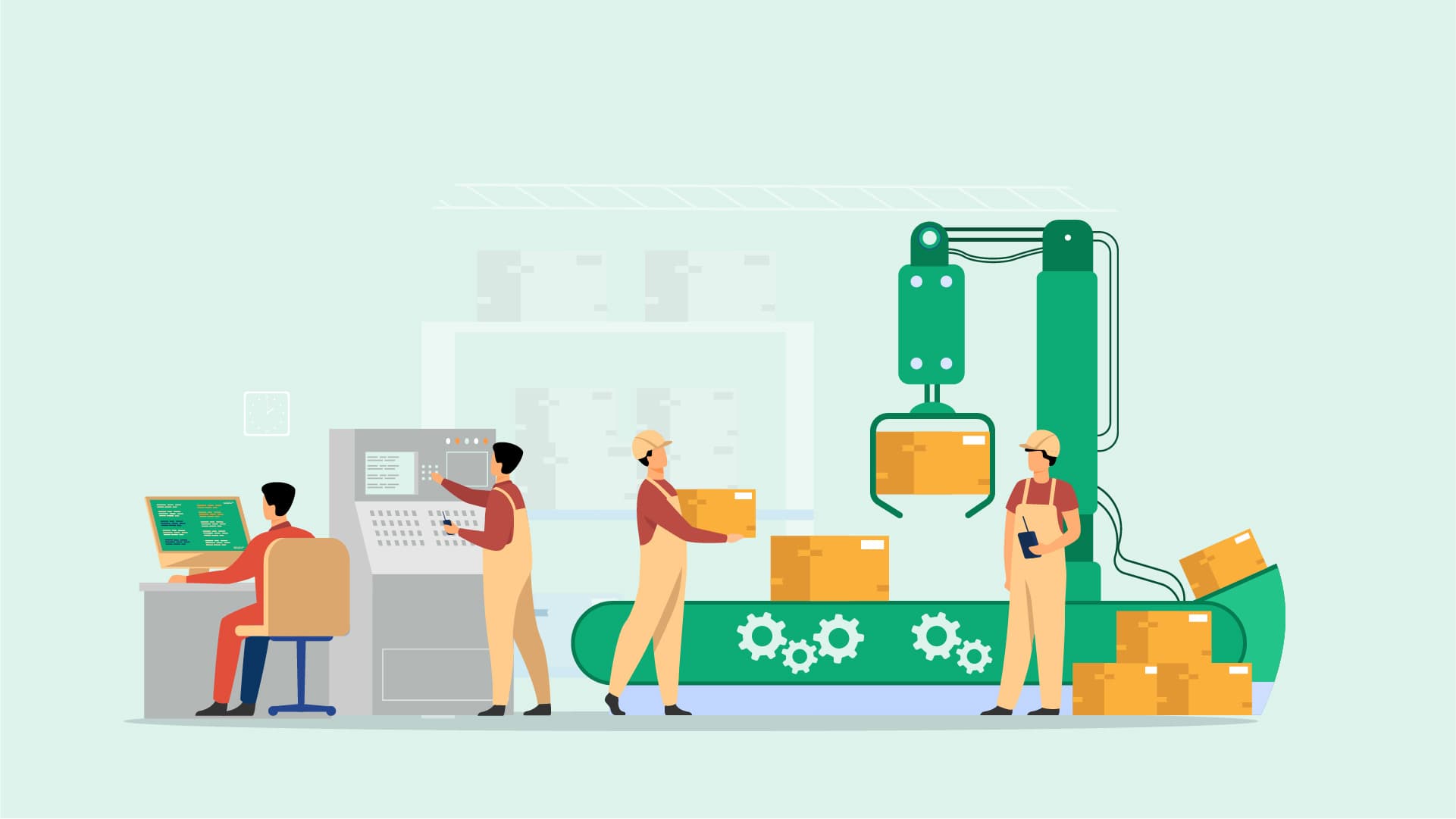
Enterprise resource planning (ERP) refers to tools used to manage and view data that impacts a business’ decisions. ERP software solutions are varied, with different functions and specialties. Typical use cases include manufacturing ERP software, accounting software solutions, and marketing and customer relationship management tools. Integrating and centralizing all your business processes allows you to easily manage and automate a wide range of business operations.
Some of the best-known ERP system examples on the market include Oracle Netsuite ERP, Microsoft Dynamics, Odoo, and SAP S/4HANA, but there are several alternatives on the market that offer better value and greater flexibility. Modern ERP software systems are extremely feature-rich and use innovative technology, like artificial intelligence, to optimize and enhance business data.
Different Types of ERP Software
ERP software is often divided into categories according to its end-use applications or specializations. With these categories, we can make even further distinctions, e.g., any of these ERP software examples could refer to either a cloud-based ERP system, an on-premises-based ERP, or a hybrid ERP system.
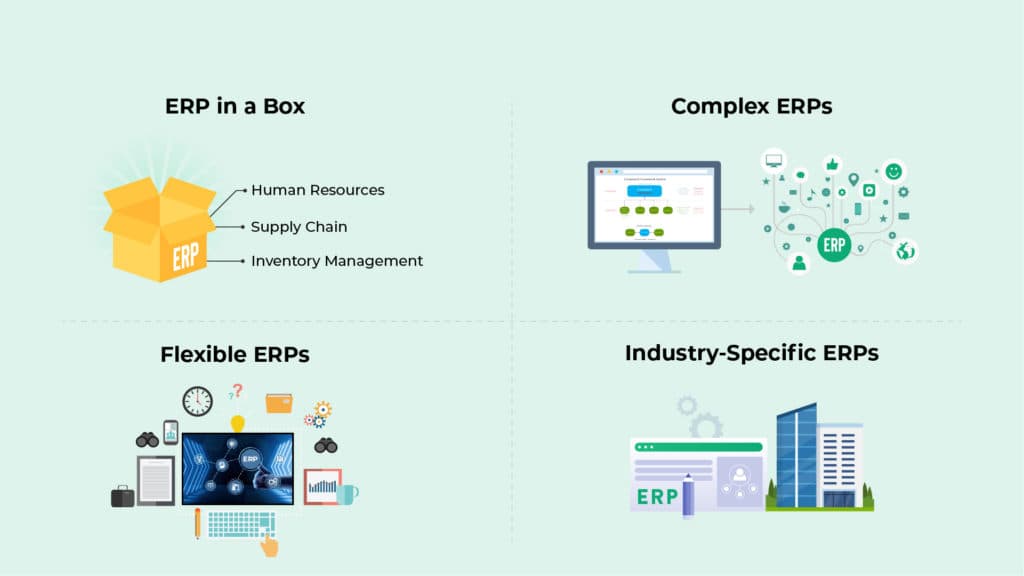
Many types of ERP systems exist, including flexible, industry-specific, complex, and in-a-box.
ERP in A Box
An ERP-in-a-box solution usually refers to an ERP solution that is easy to use and install but can’t be otherwise configured or customized. These solutions are plug-and-play, which means they meet set core business functions (e.g., human resources, supply chain, or inventory management), but it’s not possible to utilize add-ons. These solutions are best applied to cost-constrained small businesses with low growth ambitions.
Complex ERPs
Large-scale or very complex ERPs are built according to a framework provided by the business, according to their needs. They are highly customized according to the requirements of the business or industry. Large enterprises most often use these ERP systems.
Flexible ERPs
Flexible ERPs are the middle ground between the previous two examples. They can be used out of the box but are fully customizable to better meet your needs. They are best suited to medium-sized or smaller businesses with more complex needs.
Industry-Specific ERPs
Industry-specific ERPs have highly specific features and terminology designed for a specific industry. Most ERP software in this category does not have configuration or customization capabilities.
Different Cloud-Based ERP System Examples
Many businesses prefer using a cloud ERP system to manage their business processes (e.g., inventory management, financial management, human resources, and supply chain management). Cloud ERP systems can be classified as follows:
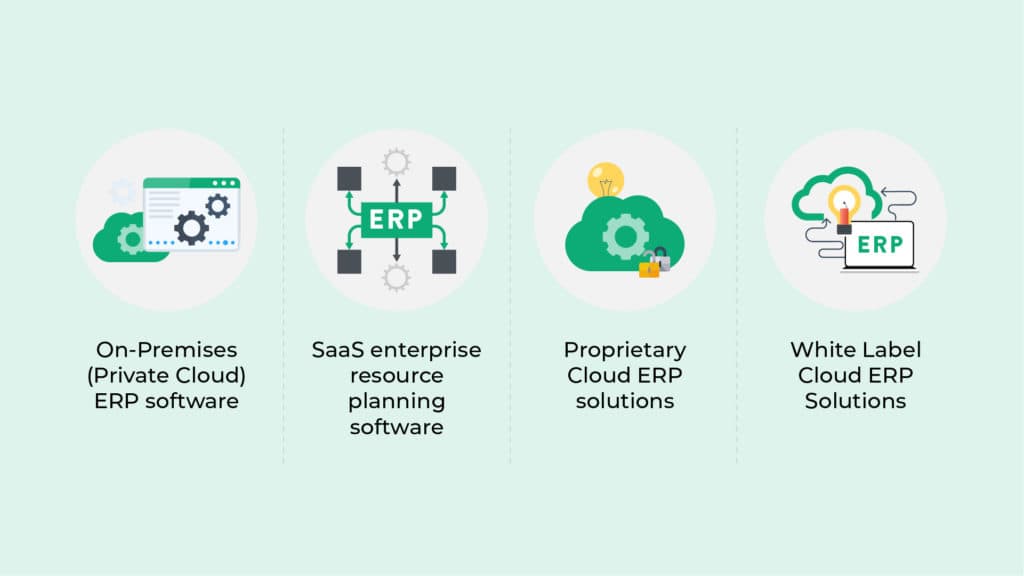
The different types of ERP software.
On-Premises (Private Cloud) ERP software
When a company chooses a private cloud enterprise resource planning system, data is stored on on-premise servers owned and managed by the company itself. The benefit of this approach is that you can combine your traditional on-premise ERP software solution with a private cloud. This is highly customizable as you can integrate it with most enterprise modules and tools. On the downside, it’s a very expensive approach as you’ll need to invest in local servers and databases, annual maintenance, licensing, and support. It’s also less secure. Most attacks occur via users’ workstations (e.g. phishing scams), so you’ll be more vulnerable to hacking due to human error. There’s also a greater risk of physical damage, e.g. a fire alarm drenching servers or a natural disaster destroying your premises. On the upside, you’ll have full control over the entire system.
SaaS enterprise resource planning software
Software as a Service (SaaS) is the most common cloud ERP software system deployment. With this model, the business doesn’t own the software. Data is stored in a public cloud where users have access to their specific company data instance based on granular security permissions for an affordable monthly fee. This method is secure, flexible, and robust enough to be highly customized and adapted according to your business needs. It can also be implemented quickly, automatically patched, and updated regularly.
Proprietary Cloud ERP solutions
A proprietary cloud ERP solution is similar to the private cloud, but the ERP vendor hosts the instance of the ERP software in their own data center. This provides great flexibility, reduced costs, and greater accountability and security. Small businesses can expand their cloud solution as their needs grow without the added cost of acquiring their own IT team to maintain the system.
White Label Cloud ERP Solutions
A white label cloud ERP system is hosted in a public IaaS (Infrastructure as a Service), such as AWS, instead of the ERP vendor’s data center. The deployment is usually either arranged by a vendor or a reseller. In the former scenario, the vendor is responsible for the data center, its management, and its implementation. The reseller model is generally considered riskier, as there are often some question marks around which party is responsible for updates or incident management.
Features of a Modern ERP System
ERP systems are designed to streamline business processes using a singular user interface to provide a convenient, seamless user experience. Several layers work together to make this happen, including a database where financial, inventory, and customer data is housed, the ERP user interface, and the program that houses the rules and logistics of the system.
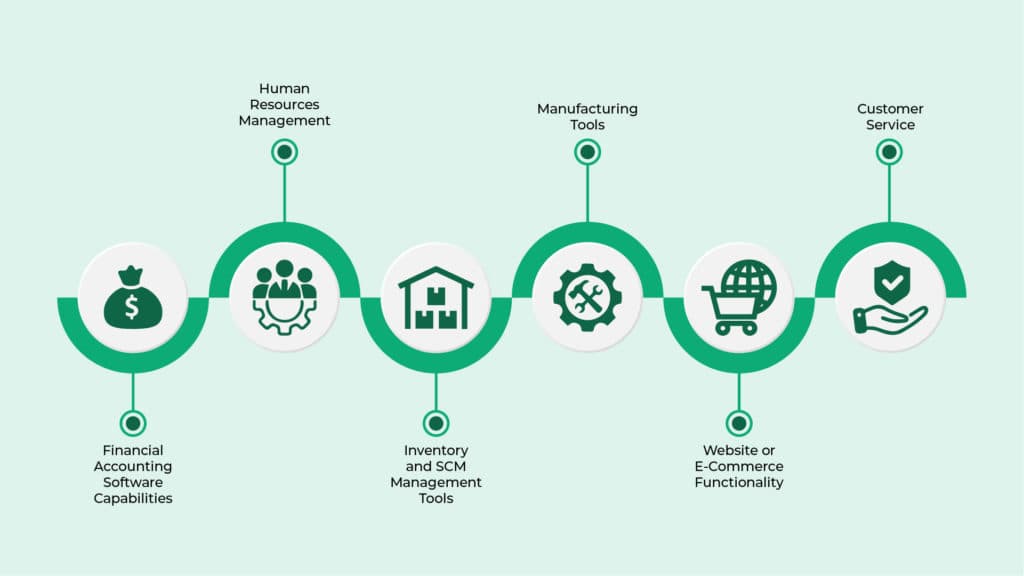
What are the core features of a modern ERP system?
Enterprise resource planning systems are extremely comprehensive and comprise many features and capabilities every ERP should offer:
Financial Accounting Software Capabilities
ERP solutions can automate payroll processes, simplify financial management, and analyze and compute financial data for reporting purposes within seconds. They can conduct cost analyses and forecast future growth, reduce human error, free up your employees’ time, and drive your company’s ability to make data-driven decisions. When the ledger is built into the platform rather than bolted on, those numbers stay accurate by design (see accounting software for distributors).
Inventory and Order Management
For product-based businesses, the system tracks stock across locations, manages units of measure, and runs the order-to-cash flow from quote to invoice. This is the heart of an ERP for a distributor.
Supply Chain and Purchasing
Demand-driven replenishment, purchase orders, and supplier management keep the right inventory on the shelf without trapping cash. The eight essential ERP modules for distributors covers these in depth.
Reporting, Business Intelligence, and AI
Real-time dashboards turn data into decisions, and modern platforms layer AI on top so you can question your live business data in plain English.
Which Type of ERP Is Right for a Distributor?
For wholesale and industrial distributors, the deciding factor is rarely the deployment model alone. It is whether the system was built for distribution in the first place. Generic and ERP-in-a-box products treat units of measure, landed cost, multi-location inventory, and customer-specific pricing as afterthoughts, while an industry-built distribution ERP makes them native.
The most effective choice for most distributors is a flexible, SaaS, industry-specific ERP: cloud-deployed for fast implementation and low maintenance, customizable enough to fit your workflows, and built around how distribution actually works. That combination is exactly what 10X ERP delivers, with inventory, orders, purchasing, and accounting on one real-time platform. If you are weighing options, our best ERP for distributors guide compares the systems distributors evaluate most.
Want to see a distribution-built ERP on your own workflows? Schedule a 30-minute demo. No pressure, just a real look at the platform.
Frequently Asked Questions
What are some examples of ERP systems? Well-known ERP system examples include Oracle NetSuite, Microsoft Dynamics, SAP S/4HANA, Odoo, and industry-specific platforms like 10X ERP for distribution. They differ widely in deployment model, customizability, and how well they fit a given industry.
What are the main types of ERP systems? ERP systems are commonly grouped by configurability (ERP-in-a-box, flexible, complex, and industry-specific) and by deployment (on-premises or private cloud, SaaS, proprietary cloud, and white-label cloud). Many real-world systems combine several of these traits.
Which type of ERP is best for distributors? Most distributors are best served by a flexible, cloud-based, industry-specific ERP that treats inventory, units of measure, landed cost, and customer pricing as native concepts rather than add-ons.
Ready to Transform Your Distribution Business?
Let us help you implement solutions that drive real results.
Contact Us TodayGet insights delivered to your inbox
Product updates, distribution industry insights, and company news.
Related Articles
Prepare Your Distribution Operations for 2027
A Q4 checklist for fastener, sealing and industrial distributors, with real results from distributors who gained throughput, cleaner books and faster fulfillment.
Why vacation season exposes operational gaps in distribution businesses
Every distribution business has that moment in July. A key person is out. A big order comes in. And suddenly everyone realizes the operation was running on tribal knowledge, not systems. Vacation season doesn't create operational gaps — it just makes them impossible to ignore. Here's why it happens and what distributors running on modern ERP do differently.
The 8 Essential ERP Modules Every Distributor Needs
A distribution ERP is only as good as its modules. Here are the 8 essential ERP modules for distributors, what each one does, and why they work best on one platform.