

The Hidden Cost of Manual Workarounds for Fastener Distributors

Every distributor has a spreadsheet that quietly runs part of the business. Nobody chose it. Everyone's afraid to retire it.
For fastener distributors, manual workarounds that live outside the ERP drain margin, tie up working capital, and create traceability risk. None of it shows up as a line on the P&L. This article shows where those costs land and gives you a simple worksheet to size them before your next budget cycle.
Key takeaways
- A mid-sized fastener distributor can lose $80,000 or more a year to manual workarounds, and that's a conservative floor.
- The measurable costs are staff time, order errors, expedited freight, and carrying cost on dead stock.
- The larger costs are harder to see: lost bids from slow quotes, missed sales from stockouts, and lot traceability exposure.
- Fast-Spec, a Texas fastener distributor, increased throughput with no added headcount after replacing manual outside-processing tracking with 10X ERP.
What manual workarounds are common in fastener distribution?
The most common workarounds in fastener distribution are spreadsheet quoting, cross-references held in veterans' heads, hand-filed mill certs and lot records, manual inventory corrections, and hand-tracked outside processing. Each one exists because the ERP doesn't handle that job well, so people fill the gap.
Ask any distributor and you'll hear the same short list:
- Quotes built from a spreadsheet instead of live inventory and pricing.
- Cross-references and substitution rules known only by two or three long-time employees.
- Mill certs and lot records filed by hand and matched to orders later.
- Inventory counts corrected on the floor because nobody trusts the system number.
- Outside processing tracked on paper or in a spreadsheet.
Outside processing (also called secondary processing) means sending parts to a vendor for work such as painting or plating, then receiving them back into stock. Someone has to know what went out, where it is, and when it's due back.
Fast-Spec, a 40-year industrial fastener and supply distributor in Arlington, Texas, previously ran its days this way. Each morning meant pulling several reports from a legacy Windows-based ERP to see what needed attention. Warehouse questions about orders and shipments landed on leadership. Painting and plating jobs were tracked by hand, with no real-time view of orders, inventory, or purchasing to check them against.
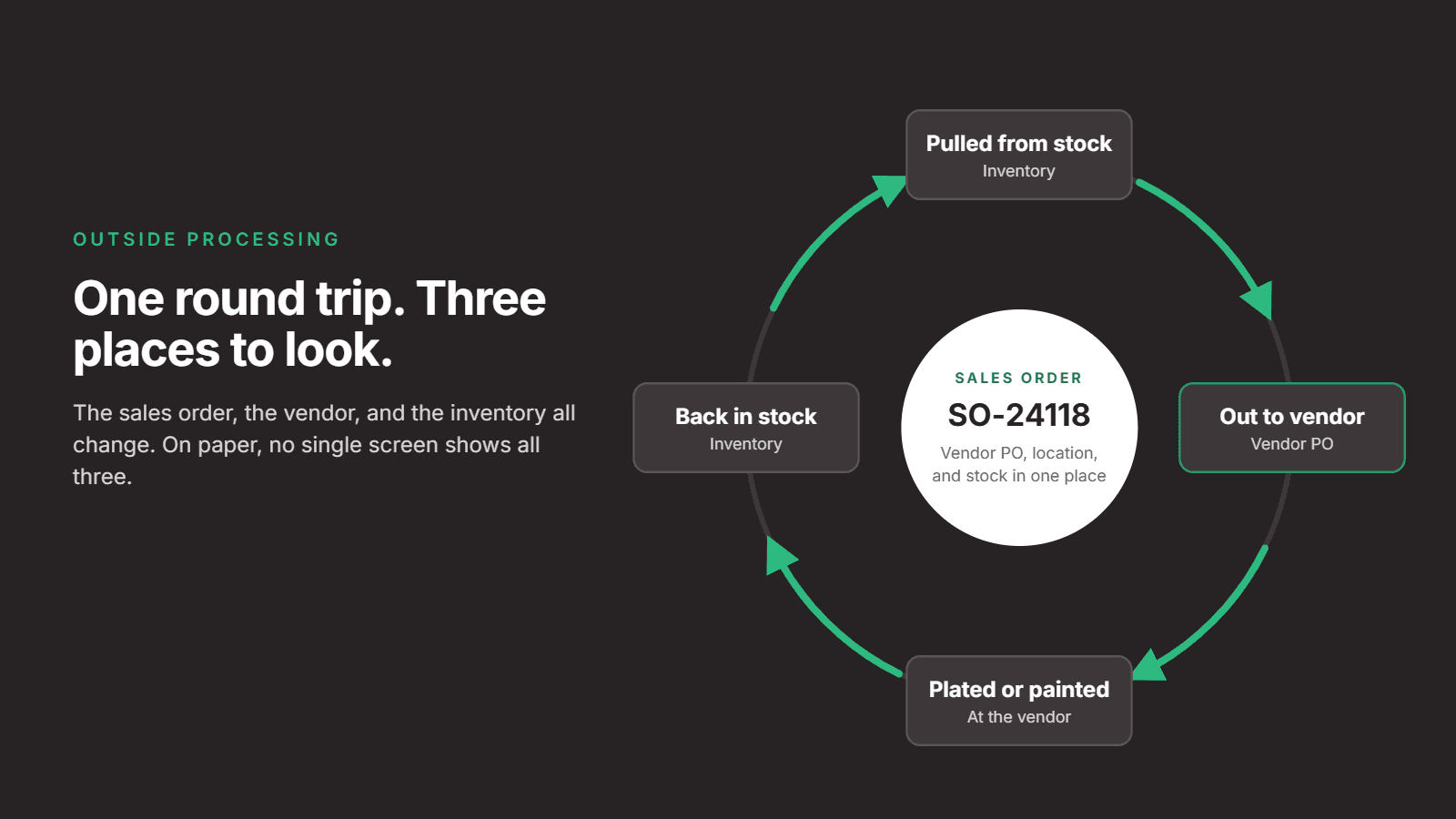
Most fastener operations have a process like this. It touches the sales order, the vendor, and the inventory, and no single screen shows all three.
How do manual workarounds hurt distributor margins?
Manual workarounds hurt distributor margins in five ways: wasted labor, slower quotes, excess and misallocated inventory, headcount that grows with every new customer, and key-person risk. Labor is the easiest to see and the smallest of the five.
Labor. Rekeying orders, reconciling counts, and chasing certs are hours you already pay for, spent on work no customer notices.
Slow quotes. Every manual lookup adds minutes between the RFQ and the quote. How many bids did that cost you last quarter? You can't know, which is the problem.
Working capital. When nobody trusts the stock numbers, buyers order extra to be safe and still run short on fast movers. The result is dead stock on the shelf and backorders at the counter: cash tied up and a lower fill rate.
Scalability. Workarounds scale with headcount. Every new customer, branch, or acquisition adds people to keep the spreadsheets running. After moving to 10X ERP, Fast-Spec reports more throughput with zero added headcount.
Key-person risk. When your best counter person retires, the substitution rules leave with them.
Why does lot traceability matter for fastener distributors?
Lot traceability lets a fastener distributor show which lot a part came from, produce its mill cert, and identify every customer who received that lot. Aerospace, defense, energy, and construction customers expect it. Without it in the system, a single bad lot can turn into a costly, company-wide recall.
Sooner or later, a customer will ask which lot a fastener came from and want the cert that goes with it. When that record lives in binders, answering takes days. If a lot turns out to be bad and you can't narrow it to the customers who actually received it, you end up calling everyone who bought the part.
One quality escape brings returns, rework, strained relationships, and sometimes lost approved-supplier status. That can cost more than years of the labor you saved by keeping lot records outside the system. It's a liability you carry whether or not it's on the books.
How do you calculate the cost of manual workarounds?
To calculate the cost of manual workarounds, add four measurable categories: staff time, order and shipping errors, expedited freight, and carrying cost on slow-moving stock. For a mid-sized fastener distributor, the illustrative total below is about $82,600 a year. Treat it as a floor.
Your operations lead can build this in an afternoon. The inputs are illustrative, so swap in your own numbers.
| Category | How to estimate | Illustrative assumption | Annual cost |
|---|---|---|---|
| Manual labor | Staff × hours per week × loaded hourly rate × 50 weeks | 3 staff × 6 hrs × $30 | $27,000 |
| Order and shipping errors | Errors per month × cost per error (credit, restock, reship) × 12 | 4 × $250 × 12 | $12,000 |
| Expedited freight | Rush shipments per month × average premium × 12 | 2 × $150 × 12 | $3,600 |
| Dead stock and slow movers | Slow-moving stock value × carrying cost rate | $200,000 × 20% | $40,000 |
| Total (conservative) | $82,600 |
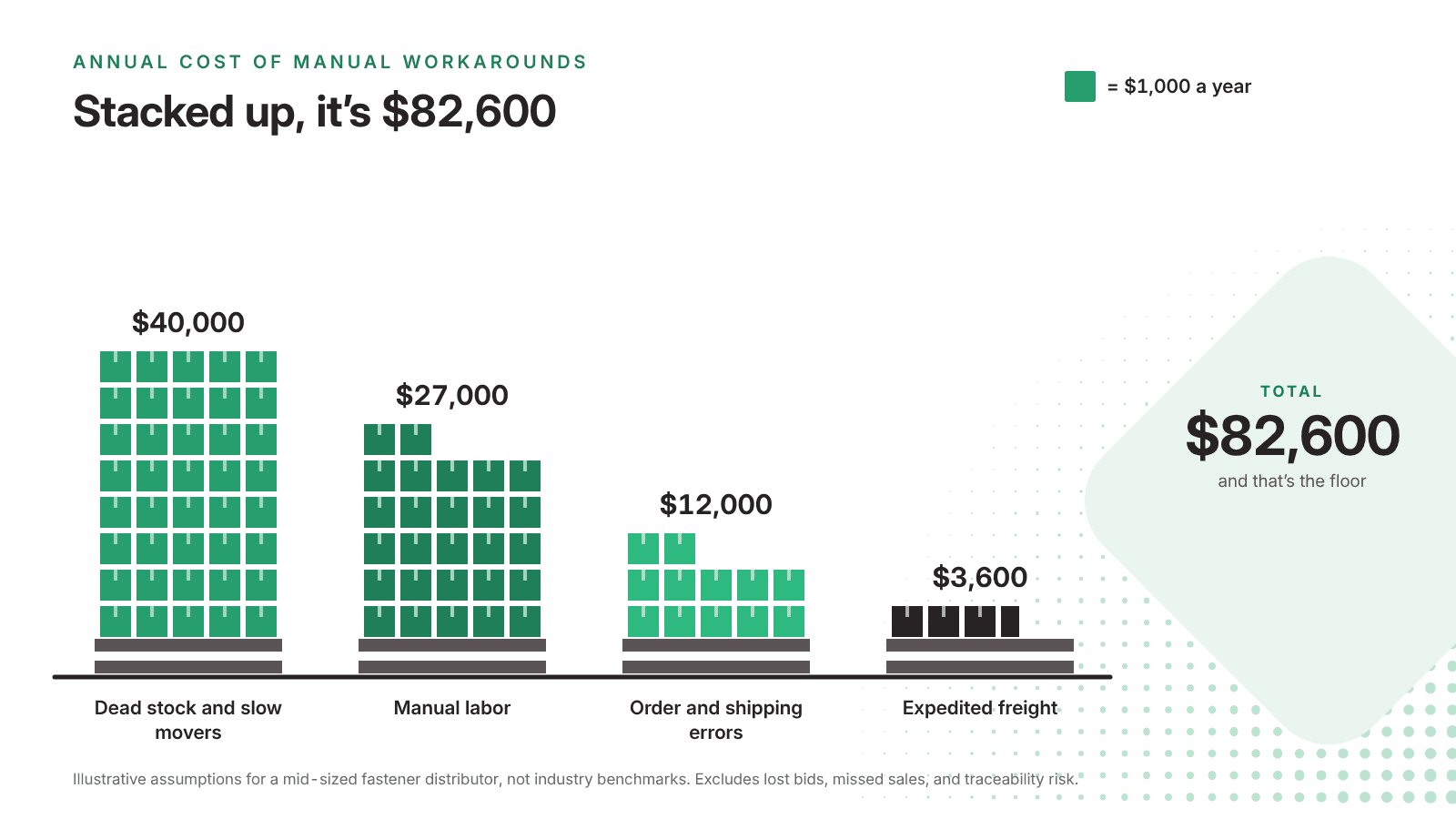
Note: Figures are illustrative assumptions, not industry benchmarks. Swap in your own numbers.
The total leaves out the most expensive items: bids lost to slow quotes, sales missed on stockouts, traceability exposure, and key-person risk.
Then ask your team what's missing. They know about workarounds you've never seen.
What should fastener distributors look for in an ERP?
Fastener distributors should look for an ERP that handles fastener-specific work natively: spec-based items, cross-references and substitutions, lot traceability with certs, quoting from live inventory, demand-based replenishment, and outside processing tied to the sales order. They should also get implementation answers in writing before signing.
Fast-Spec didn't want a generic system it would have to force-fit, and that's a sound first filter. In 10X ERP, the purchase order for an outside service links back to the original sales order, and the part's location is tracked at each stage until it returns. Frank Thomason, VP of Sales at Fast-Spec, says of that change: "This one improvement alone has saved significant time and increased our throughput."
Before you commit to any platform, ask these questions:
- Fastener-specific functions. Does it handle spec-based item records, cross-references, substitutions, and bulk stock natively, or is that custom work you'll maintain yourself?
- Lot traceability. Can it trace a lot from receiving to shipment and show the cert to whoever is taking the order?
- Quoting. Can sales quote from live inventory and customer pricing without a side spreadsheet?
- Replenishment. Does it reorder based on demand and lead times, or on min/max numbers someone set years ago?
- Outside processing. Is the vendor PO linked to the sales order, with the part's location visible until it returns?
- Implementation. How will your data migrate, how long will it take, and who answers the phone when something breaks?
Get the implementation answers in writing, and ask for a reference from a distributor who has been through it. Phasing the rollout, starting with the workaround that costs you most, keeps the day job running while you switch.
Where should you start?
Start by listing five workarounds in your own shop. For each one, write down who does it, how many hours a week it takes, and what happens when it goes wrong. That's your starting number, and it's usually bigger than anyone expected.
If your team spends more time working around your ERP than working in it, that number is your case for change.
Schedule a 30-minute demo built around your quoting, inventory, and traceability, not a generic pitch.
Frequently Asked Questions
What is outside processing in fastener distribution?
Outside processing, also called secondary processing, is when a distributor sends parts to a vendor for finishing work such as plating, painting, or heat treating, then receives them back into inventory. An ERP should link the vendor purchase order to the original sales order and track where the parts are until they return.
What carrying cost rate should a distributor use for dead stock?
Distributors commonly put annual inventory carrying cost at roughly 20% to 30% of stock value, a rule of thumb that covers capital, storage, insurance, shrinkage, and handling. Industrial distributors tend to run near the high end, around 28%, so the 20% used in this article's worksheet is conservative.
Do fastener distributors need lot and serial traceability?
Distributors selling to aerospace, defense, energy, or construction customers generally need it, because those customers ask for lot history and mill certs. Traceability also limits the damage from a bad lot, since you can contact only the customers who received it.
How much do manual workarounds cost a fastener distributor?
For a mid-sized distributor, measurable costs such as labor, errors, rush freight, and dead stock can reach about $82,600 a year. That excludes lost bids, missed sales, and traceability risk, so the true cost is usually higher.
How long does an ERP implementation take for a distributor?
Most distributor ERP implementations take several months, depending on data quality, number of locations, and integrations. 10X ERP targets launch in about 100 days, using a four-stage process: Discovery, Planning, Launch, and Orbit.
Ready to Transform Your Distribution Business?
Let us help you implement solutions that drive real results.
Contact Us TodayGet insights delivered to your inbox
Product updates, distribution industry insights, and company news.
Related Articles

Prepare Your Distribution Operations for 2027
A Q4 checklist for fastener, sealing and industrial distributors, with real results from distributors who gained throughput, cleaner books and faster fulfillment.

Why vacation season exposes operational gaps in distribution businesses
Every distribution business has that moment in July. A key person is out. A big order comes in. And suddenly everyone realizes the operation was running on tribal knowledge, not systems. Vacation season doesn't create operational gaps — it just makes them impossible to ignore. Here's why it happens and what distributors running on modern ERP do differently.

The 8 Essential ERP Modules Every Distributor Needs
A distribution ERP is only as good as its modules. Here are the 8 essential ERP modules for distributors, what each one does, and why they work best on one platform.